Crux Wins 2026 PDA Drug Delivery Innovation Award
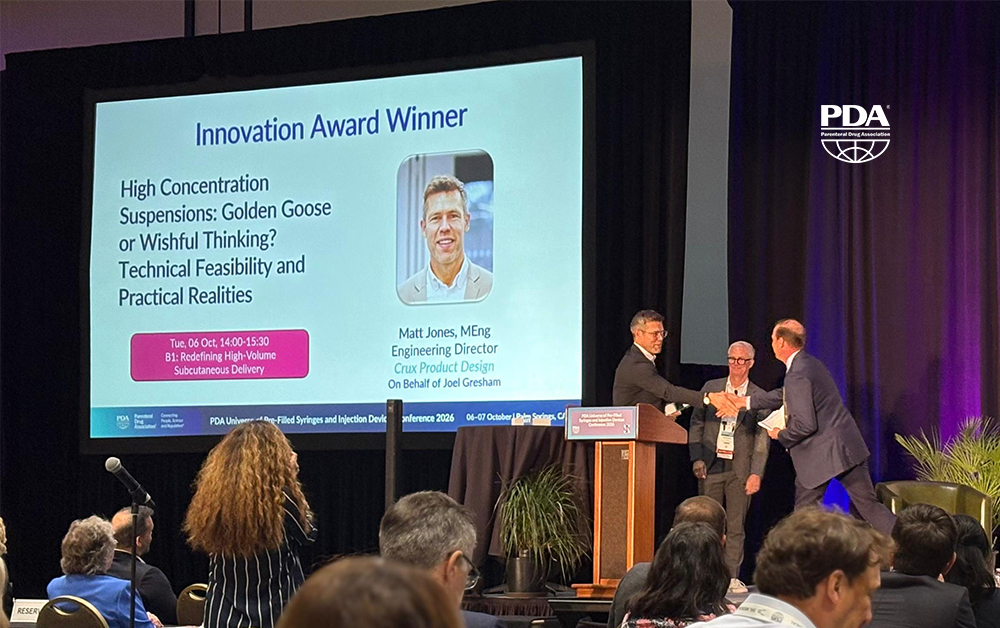
Crux has been awarded the PDA Drug Delivery Innovation Award at the PDA Universe of Pre-Filled Syringes and Injection Devices Conference 2026 for our paper, “High Concentration Suspensions: Golden Goose or Wishful Thinking? Technical Feasibility and Practical Realities”. The award recognises our pioneering research into the challenges associated with developing, manufacturing and delivering high-concentration injectable suspension formulations and the novel methods being used to address them.
Led by Joel Gresham, Chief Scientist at Crux, the paper examined a question that is receiving growing attention across the pharmaceutical industry: can high-concentration suspensions unlock patient-friendly delivery of high-dose therapeutics, or do practical challenges make widespread implementation unrealistic?
The PDA Drug Delivery Innovation Award recognises the hard work, curiosity and capability of the Crux team and our clients across multiple projects in advancing understanding in this challenging field. We are delighted to see this work recognised by the industry and look forward to continuing the development of the methods and technologies needed to transform promising concepts into commercially viable products.
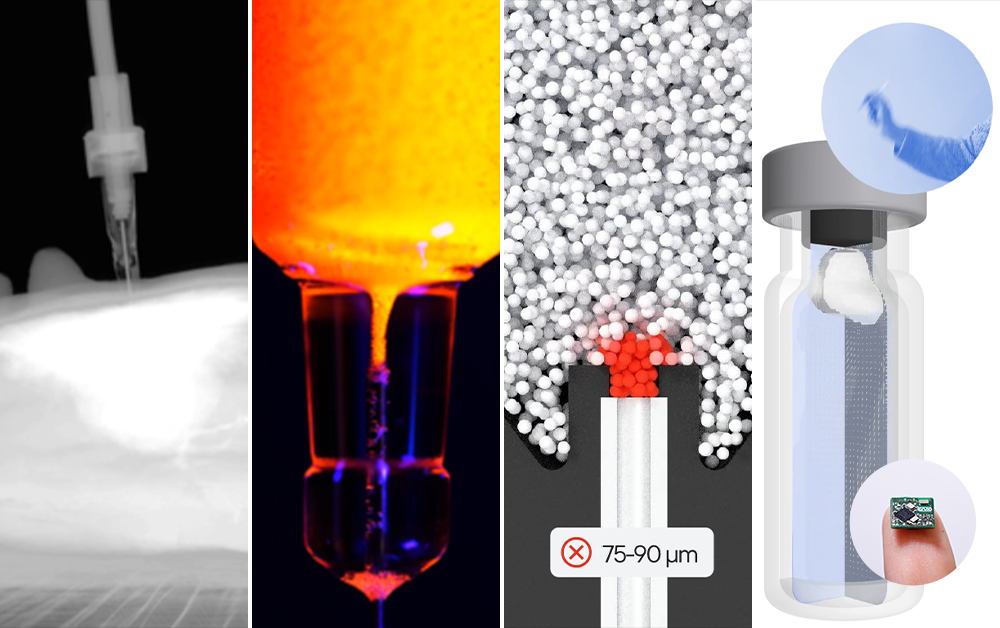
Crux's toolkit reveals the science behind successful suspension formulation and delivery.
Why High-Concentration Suspensions Are Attracting Interest
There is growing demand to deliver larger doses through convenient subcutaneous injection, offering the potential to dramatically reduce dosing frequency. High-concentration suspensions represent one possible route, enabling substantially higher drug loading than conventional solution formulations while maintaining injection volumes below 2 mL, where tolerability is well established.
While these medicines could significantly reduce treatment burden for both patients and healthcare systems, they also introduce a new set of technical challenges that extend far beyond formulation science.
A System-Level Challenge
Suspension products must be considered as a complete system rather than as an isolated formulation problem.
From manufacturing and filling through storage, re-suspension, injection and drug absorption, each stage can influence the next. Particles settle during storage, sediments may become difficult to re-suspend, and agglomerates can form that affect injection performance.
This creates a highly interconnected development challenge spanning formulation, device engineering, manufacturing, human factors and clinical performance.
New Tools for New Problems
Many of the established tools and metrics used for injectable solutions are not well suited to complex suspensions, creating a need for new approaches to understand their behaviour.
One example explored in the paper is resuspension performance. Image analysis, modelling and bespoke test methods are being developed at Crux to provide objective measures of suspension homogeneity, while helping to quantify the effects of formulation properties, device design and user interaction.
Successful resuspension is only part of the challenge. Needle blockage remains a significant risk, and simulation combined with advanced imaging can be used to understand how factors such as particle size distribution, agglomeration behaviour and concentration influence its occurrence.
It is equally important to understand what happens after injection, including depot formation, dissolution and the resulting impact on pharmacokinetic performance.
Together, these considerations highlight the need to evaluate suspension products holistically rather than optimising individual parameters in isolation.
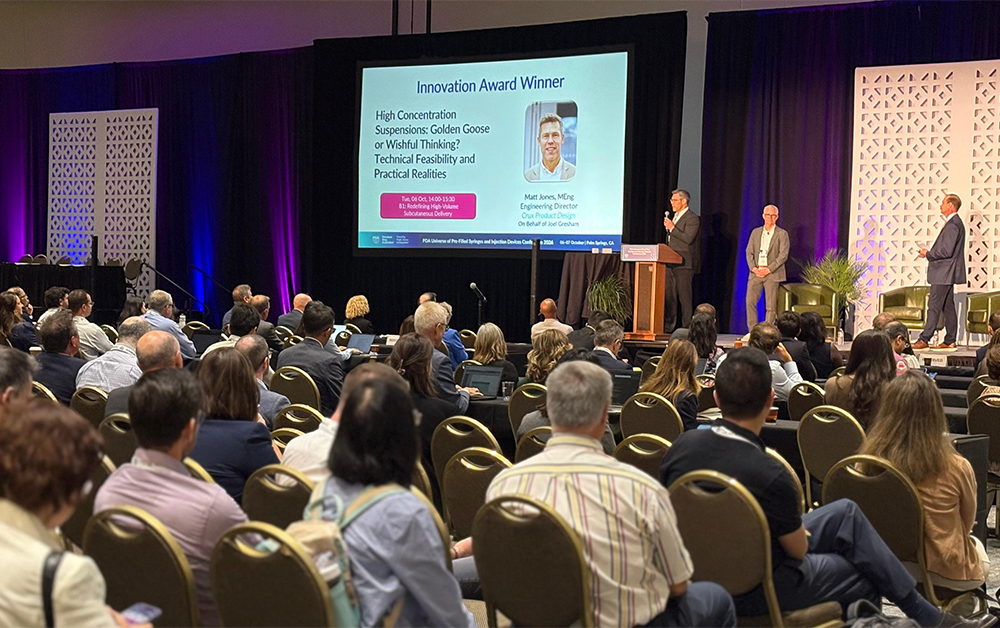
Matt Jones of Crux, accepting on behalf of Joel Gresham, the PDA Drug Delivery Innovation Award at the PDA Universe of Pre-Filled Syringes and Injection Devices Conference 2026.
Golden Goose or Wishful Thinking?
The conclusions of the research were cautiously optimistic. High-concentration suspensions offer enormous potential but present significantly greater challenges than conventional solution-based formulations.
New methods and metrics are needed to understand performance and establish appropriate acceptance criteria across the product lifecycle, from manufacturing and storage through to delivery and dissolution. To address these challenges, Crux is developing innovative analytical methods, modelling approaches and delivery technologies. However, there is no single breakthrough that guarantees success. Effective development requires informed decision-making across formulation, device design, manufacturing, human factors and clinical disciplines from the earliest stages of a programme.
Ultimately, high-concentration suspensions represent a promising opportunity, but one that demands a multidisciplinary approach and a deep understanding of the complex interactions that drive product performance.
If you would like to chat with us about our work, get in touch.