Celebrating Clinical Trials Day: The Role of Human Factors in Clinical Research
Authored by Carlie Sylvan, Human Factors Engineer
Today is Clinical Trials Day, a global celebration recognizing the clinical researchers who work tirelessly to discover new medicines and the patient communities who participate in trials to advance these new treatments. Observed each year on 20 May, the date marks the first randomised clinical trial on record conducted almost 300 years ago. In 1747, James Lind, a ship’s surgeon in the British Royal Navy, conducted a trial with 12 sailors testing citrus fruits as a treatment for scurvy.
From citrus fruits to cancer therapies, the modern clinical trial has advanced leagues beyond Lind’s initial investigation while maintaining the same core principle of evidence-based treatment. Today, clinical trials generate the evidence needed to ensure treatments on the market are safe and effective.
Clinical Trials and the Link to Device Development
Drug delivery is often inseparable from the therapy itself. At Crux, we support our clients in the development of drug delivery devices such as autoinjectors, inhalers, and syringes i.e. “combination products” regulated as both a medical device and drug product. Many of the devices developed at Crux will eventually be used in clinical trials and ultimately be the mechanism through which patients receive life-changing treatment.
While clinical studies primarily evaluate the safety and efficacy of the medication, Human Factors (HF) studies assess how safely and effectively users interact with the device. For combination products, these disciplines are closely linked.
Top 5 Facts on Human Factors and Clinical Research
1 – Timing of HF Studies and Clinical Trials
Human factors studies are typically conducted in two stages: formative and validation. Formative evaluations are iterative, used to identify usability issues, gather user feedback, and inform design improvements. Validation tests are conducted with the final on-market equivalent user interface, including all packaging and labelling, to ensure it supports safe and effective use with intended users in intended use environments.
Formative HF evaluations are often conducted in parallel with early-stage clinical trials which test the treatment with small sample sizes. Contingent on promising early results, a major clinical trial (Phase 3) is conducted with hundreds to thousands of patients to confirm the treatment’s efficacy.
The FDA recommends that HF validation tests be conducted before major clinical trials so that the HF-validated device can be used in the clinical trials to achieve the most accurate results possible. The diagram below, adapted from the Society of Clinical Research Associates, shows the general timing of HF and clinical studies for combination products.
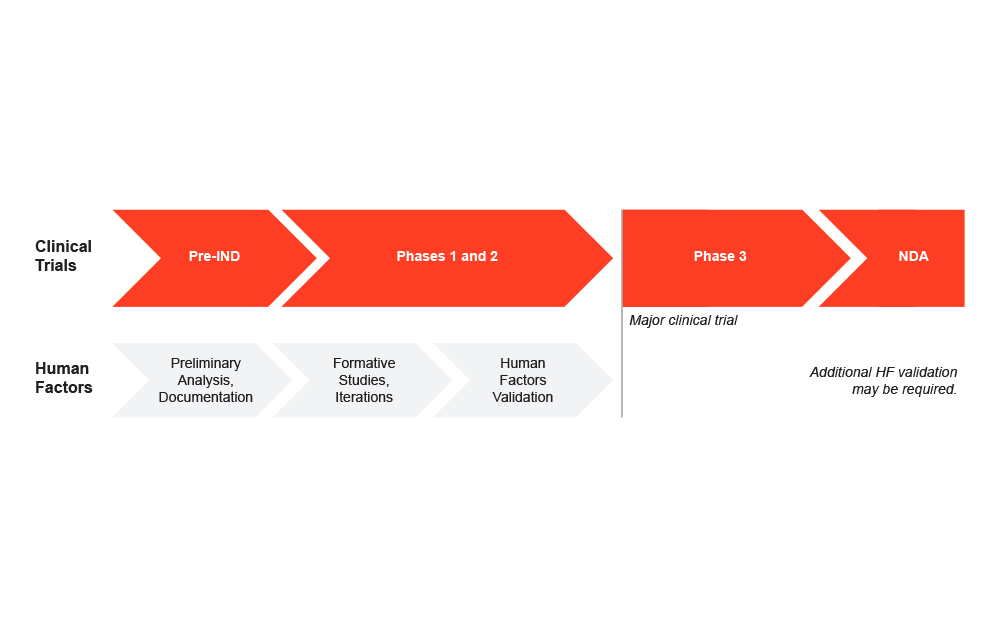
Adapted from the Society of Clinical Research Associates
2 – Impact of Usability Issues on Clinical Trial Data
Conducting HF validation tests before major clinical trials, as recommended by the FDA, supports more reliable trial outcomes by identifying usability issues early in development.
For example, if a clinical trial for an inhaled respiratory medication is conducted before HF validation, subjects may misuse the device (e.g., not holding a button for long enough), resulting in an under-dose. If this occurs across multiple subjects, the treatment may incorrectly appear ineffective. Conducting formative evaluations and validation tests beforehand aims to identify and mitigate these issues (e.g., with improved instructions).
This is increasingly important as more trials move into decentralized, at-home settings without clinical supervision, where patients must rely on the device design and labelling to use it correctly.

3 – HF vs. Clinical Trial Study Environment
Clinical and HF studies have distinct goals and environments. Clinical studies focus on treatment efficacy, typically in controlled settings where subjects are trained in how to use the devices. Human factors studies, on the other hand, aim to simulate a real-world environment as closely as possible, including representation of worst-case scenarios. HF participants are usually untrained, allowing researchers to assess whether the device can be used safely and effectively in real-world scenarios.
This difference underscores how these studies are complementary parts of the combination product development cycle. Clinical trials evaluate drug efficacy assuming correct use, and HF studies evaluate usability assuming drug efficacy. Together, they help isolate difficulties in the device proposition and develop effective solutions for patients.

4 – Use-related Risk Analysis for Clinical Trials
As part of clinical trial regulatory submissions, sponsors submit protocols detailing how the trial will be conducted. The FDA then evaluates these to ensure the safety and welfare of human subjects. In alignment with this goal, the FDA recommends conducting a Use-related Risk Analysis (URRA) in the context of the clinical trial.
A URRA is a document frequently prepared for HF regulatory submissions to the FDA, evaluating tasks for foreseeable use-related risks and mitigations. Applying this HF analysis to clinical investigations helps identify potential use errors and clinical consequences.

5 – HF Validation for Product Design Changes within the Clinical Timeline
Design changes to combination products may require an additional HF validation test, particularly if changes occur after clinical studies or a prior validation test. With any design change, the FDA recommends the device URRA be updated to reflect any new risks brought on by the change. Whether additional HF validation is required depends on the acceptability of the updated URRA. Where needed, a supplementary validation test can often be limited to use scenarios, critical tasks, and user groups impacted by the change rather than the entire scope of device use.

Bridging HF and Clinical Research
On Clinical Trials Day, we’re proud to contribute to the work of researchers, patients, and partners working to advance safe and effective treatments. By integrating human factors and usability early and throughout development, we help identify and mitigate use-related risks for our clients before they impact clinical outcomes.
The recently opened Crux Technology Centre (CTC) in Bristol, UK features HF study spaces designed to simulate clinical environments with high levels of realism, resulting in more actionable insights and ultimately a better participant experience. Get in touch to learn more.