Celebrating National Engineers Week with Crux’s Head of Mechanical Engineering
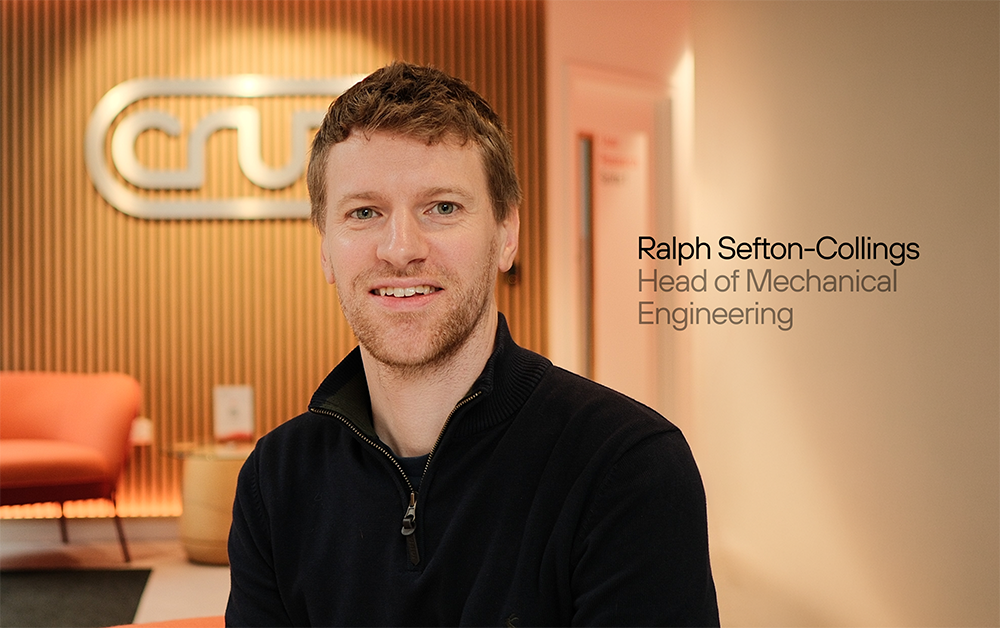
Each year, National Engineers Week highlights the positive impact engineers have on the future of technology and design. At Crux, this resonates strongly with how we think about growth, collaboration and supporting the next generation of talent.
We recently caught up with Ralph Sefton-Collings, who has stepped into his new role as Head of Mechanical Engineering, for a Q&A on Crux’s growing presence in the United States and how we’re continuing to support the industry through STEM initiatives.
Crux’s US presence has grown significantly. How is the mechanical engineering function supporting that expansion on the ground?
Crux have supported US-based clients on some of the toughest challenges in medical and consumer goods development for more than a decade. Establishing a hub in the heart of Boston’s Kendall Square was a natural next step. Our office in ‘the most innovative square mile on the planet’ provides the perfect base for Crux engineers when working in close partnership with American clients.
2025 was an exciting year for the Boston office, with a surge in user studies expertly handled by a growing, talented team. In many cases, Crux utilise instrumented devices to allow user feedback to be evaluated with the help of powerful, quantitative data such as user force, grip or device orientation. The Mechanical Engineering team is often called on to support such studies in Boston, preparing our proprietary devices for use, ensuring they remain accurately calibrated and processing the data generated.
You’ve recently stepped into the role of Head of Mechanical Engineering. What are your immediate priorities for the team this year?
Our team has been enormously successful in winning repeat business through the delivery of exceptional work, whilst we are delighted to continue welcoming new client partners. My immediate priorities are focused on the growth in the Mechanical Engineering team. That means the short- and medium-term recruitment of outstanding individuals to join us, investment in our team’s capabilities and bringing in new equipment to allow us to work more efficiently on ever-more intriguing projects at the cutting-edge of development.
How are you ensuring the team continues to deliver consistently high standards as the business scales?
This is a great question! At Crux, the quality of our delivered work has always been absolutely paramount. In the Mechanical Engineering team we approach this from two angles. My talented colleague and Crux’ Chief Engineer, Will Japp, has a dedicated focus on ensuring that ongoing project work meets the extremely high ‘Crux bar’. In contrast, my remit is predominantly focused off projects, ensuring we have the people, capabilities and systems in place to facilitate exceptional work. Together we are working hard to shine a light on exemplary work, develop best practices, expose our team to development opportunities, streamline our processes, and recruit new engineers who meet our unwavering standard.
STEM and outreach remain a focus for Crux. Why is investing in early engineering talent important for the industry and for the business?
As a student it can be difficult to appreciate what engineers really do! Through outreach programmes we provide students with a glimpse into our world, perhaps providing the inspiration they need to become the engineers of the future. We are privileged to work in a creative industry which allows us to solve engaging mental challenges on a daily basis to develop incredible products and devices. We love what we do, and if we can share some of that enthusiasm with students to stimulate an interest in an engineering career we benefit as an industry and as a company. We support a range of initiatives, from mentoring college students and lecturing in universities through to running of design projects with girls in high school.
Looking ahead, where do you see the biggest opportunities for mechanical engineering at Crux over the next year?
The opportunities are limitless and there are some compelling industry challenges to tackle as we move through 2026.
In the drug delivery space, the rapid rise in GLP-1 medicines for weight loss treatment continues to present unique design problems as pharmaceutical companies seek to find and develop the best devices to meet the needs of a new, naïve user group. Meanwhile, we are experiencing strong demand for design support in ocular drug delivery, dry powder inhalation and large volume injection devices as treatments continue to emerge in these areas. In a wider medical context we have tackled some fantastic projects in surgical and diagnostics applications recently and look to continue our growth trajectory in these markets to diversify our offering.
In the fast-moving consumer goods space, the focus is firmly on sustainability. We anticipate further work in the design and adaptation of packs to support a refillable or reusable model of consumption. Where this is not possible, projects seek to reduce waste and ease recycling. Combining proprietary lifecycle analysis tools, industry-leading in-silico simulation capability and a talented team, Crux are in a great position to assist as the industry ushers in a new generation of cleaner, more sustainable products. Personally, I cannot wait to see what we can achieve.